
The India-EU free trade agreement negotiations concluded on 27 January 2026, but the published negotiated texts are not yet a binding basis for applying a customs preference. The European Commission says the texts are for information only, may change during legal revision, are without prejudice to the agreement's outcome, and become final at signature. It also says the agreement becomes binding under international law only after both parties complete the internal legal procedures required for entry into force. (European Commission, text of the agreements) For a company making a decision now, the practical split is simple: use the negotiated drafts for verification and conditional scenarios, but use confirmed current sources for customs entries, product classifications, duties, and live quotes.
Status at 5 September 2026: negotiation concluded, negotiated drafts published, and no signature date or entry-into-force date stated on the cited European Commission pages. (European Commission, agreement overview; European Commission, text of the agreements)
Did the EU make a trade deal with India?
Yes, India and the EU concluded the free trade agreement negotiations on 27 January 2026, but negotiation conclusion is not the same as entry into force. (European Commission, text of the agreements)
The distinction matters because a negotiated outcome, a published draft, a signed agreement, and an agreement in force are different statuses. The European Commission published the negotiated texts for information purposes only. It states that they may undergo further modification during legal revision, are without prejudice to the agreement's outcome, and will become final upon signature. (European Commission, text of the agreements)
The Commission also states that the agreement becomes binding on the parties under international law only after each party completes the internal legal procedures necessary for entry into force. (European Commission, text of the agreements) A company should therefore describe the current material as a negotiated draft, not as an effective customs preference.
For the earlier release-focused briefing, read what European SMEs should do with the published text.
What is the status of the EU-India trade agreement in 2026?
As of 5 September 2026, the European Commission reports that negotiations have concluded and negotiated drafts have been published. Its cited pages state no signature date or entry-into-force date. (European Commission, agreement overview; European Commission, text of the agreements)
The following table separates the supported status from the decision a company can take from it.
| Stage | What the European Commission says | Company treatment |
|---|---|---|
| Negotiations concluded | Negotiations concluded on 27 January 2026. (European Commission, text of the agreements) | Record a completed negotiation milestone, not entry into force. |
| Negotiated drafts published | The texts were published for information purposes only. (European Commission, text of the agreements) | Use them as draft evidence and label them accordingly. |
| Legal revision and translation | Legal revision and translation into all official EU languages are listed among the next steps, and the drafts may be modified during legal revision. (European Commission, agreement overview; European Commission, text of the agreements) | Do not assume that draft wording is fixed. |
| Signature | The Commission lists a proposal of the agreement to the Council, Council adoption, and EU-India signature. It says the texts become final at signature and states no signature date. (European Commission, agreement overview; European Commission, text of the agreements) | Recheck the final text after signature. |
| Internal procedures | The Commission lists European Parliament agreement and a Council decision concluding the deal; each party must complete the internal legal procedures necessary for entry into force before the agreement becomes binding under international law. (European Commission, agreement overview; European Commission, text of the agreements) | Keep commercial scenarios conditional until the required procedures are confirmed complete. |
| Entry into force | The Commission says the agreement can enter into force once India also ratifies it. The overview states no entry-into-force date. (European Commission, agreement overview) | Do not apply a preference solely because negotiations concluded or a draft was published. |
Use two visible labels wherever the draft informs an internal decision:
- Negotiated draft: identifies the status of the published material. The Commission says the published texts are for information only and may change during legal revision. (European Commission, text of the agreements)
- Not effective until confirmed: prevents a draft scenario from being mistaken for the treatment applicable to a live transaction. The agreement becomes binding under international law only after both parties complete the internal legal procedures required for entry into force. (European Commission, text of the agreements)
A headline can report that negotiations are finished. It cannot establish that a draft tariff line is effective for a customs declaration.
Is the published EU-India FTA text legally binding?
No. The Commission describes the published texts as informational drafts and states that binding status under international law follows completion of each party's required internal procedures for entry into force. (European Commission, text of the agreements)
The Commission sets two separate markers. The texts may change during legal revision and become final upon signature. The agreement becomes binding on the parties under international law only after each party completes the internal procedures required for entry into force. (European Commission, text of the agreements)
This means the published material can help a company locate provisions that may affect a product. It should not be described as an available preference, a guaranteed future result, or an approved basis for invoicing.
The same distinction belongs in board papers, distributor discussions, and customer-facing assumptions. The decision question is not whether a headline calls the negotiations complete. It is which source supports the treatment for the product at the time of the transaction.
What happens before the agreement enters into force?
The Commission's stated EU sequence includes legal revision and translation, a proposal of the agreement to the Council of the EU for signature and conclusion, Council adoption, signature, European Parliament agreement, and a Council decision concluding the agreement. (European Commission, agreement overview)
The Commission says the agreement can enter into force once India also ratifies it. The overview does not assign dates to those pending stages. (European Commission, agreement overview)
A company tracking implementation can use this sequence:
- Save the official source URL and evidence date beside every draft provision used in planning.
- Keep the draft provision separate from the current treatment used for a transaction.
- Recheck the text after signature because the Commission says the texts become final at signature. (European Commission, text of the agreements)
- Confirm completion of the internal procedures required for entry into force before treating the agreement as binding under international law. (European Commission, text of the agreements)
- Obtain customs or legal advice when the decision requires a binding classification or legal interpretation.
Talk to an India market specialist
Which cars will get cheaper in India after the EU deal?
The cited European Commission pages do not establish which cars will become cheaper, what their final prices will be, or when any price change will occur.
The negotiated text is not yet a binding basis for a customs preference. That status does not support a model-level retail-price claim. (European Commission, text of the agreements)
A manufacturer, supplier, or buyer should replace the broad car-price question with product-specific checks:
- What is the product's verified HS code?
- Which exact draft schedule row is being considered?
- Which origin provision and product-specific material require verification?
- What current applied duty does the competent customs source show on the evidence date?
- Does the quote distinguish current treatment from a draft scenario marked “not effective until confirmed”?
- Who owns the assumption if the final text, classification, origin analysis, or entry-into-force position differs?
The machinery and industrial equipment guide provides a sector navigation page. The western exporters guide provides wider commercial context. Neither replaces transaction-specific customs or legal verification.
No model, component, or product line should inherit a tariff or price assumption from a sector headline.
Which FTA chapters should a manufacturer verify?
A manufacturer should start with the published materials for goods, origin, customs, product requirements, trade remedies, intellectual property, exceptions, and final provisions, then narrow the review to its product and transaction.
The negotiated package lists chapters covering goods, origin, customs, sanitary and phytosanitary measures, technical barriers, trade remedies, services, digital trade, intellectual property, SMEs, transparency, good regulatory practices, sustainable food systems, sustainable development, dispute settlement, institutional provisions, exceptions, and final provisions. (European Commission, text of the agreements)
The table below is Tensor Advisory's decision rubric. Its questions are review prompts, not conclusions about coverage or legal effect.
| Published material | Question for the product line | Evidence to retain |
|---|---|---|
| National treatment and market access for goods, Chapter 2. (European Commission, text of the agreements) | Which draft schedule line corresponds to the verified HS code? | Exact schedule reference and retrieval date. |
| Rules of origin and origin procedures, including product-specific origin material, Chapter 3. (European Commission, text of the agreements) | Which article and annex must be checked for this product? | Exact reference and unresolved inputs. |
| Customs and trade facilitation, Chapter 4. (European Commission, text of the agreements) | Which documentary or customs-process questions need confirmation? | Source passage and advice received. |
| Sanitary and phytosanitary measures and technical barriers to trade, Chapters 5 and 6. (European Commission, text of the agreements) | Which product requirements should the regulatory owner review? | Requirement source, owner, and evidence date. |
| Trade remedies, Chapter 7. (European Commission, text of the agreements) | Is specialist review needed before using a landed-cost assumption? | Question log and adviser response. |
| Intellectual property, Chapter 10. (European Commission, text of the agreements) | Which terms need review for the proposed transaction? | Contract issue and cited provision. |
| Exceptions and final provisions, Chapters 19 and 20. (European Commission, text of the agreements) | Could the operative or final wording affect how another provision is read? | Cross-reference and review note. |
Can a company use the draft tariff schedule today?
A company can use the draft schedule as informational evidence for a conditional scenario, but not as proof that a customs preference is effective. The published text's current legal status still applies. (European Commission, text of the agreements)
For every product quote, separate the following fields:
- Current applied duty, with the competent customs source and evidence date.
- Draft schedule scenario, visibly marked “not effective until confirmed.”
- Product classification, with its source or an open verification item.
- Origin question, with the article or annex still requiring review.
- Commercial assumption, with the owner authorised to approve it.
This separation prevents draft evidence from silently replacing the current evidence used for a live transaction. Keep market-entry work independent from an assumed preference. Use the India market-entry strategy guide for route-to-market planning. The India sourcing guide supports a separate sourcing review.
How do you build a product-line verification sheet?
Use one row per product line, cite every external input, and keep the draft scenario separate from current treatment. This worksheet is Tensor Advisory's proposed decision method, not a statement of law.
| Product line | HS code source | Draft schedule reference | Origin reference to verify | Current duty source | Quote assumption | Owner | Evidence date | Status flag |
|---|---|---|---|---|---|---|---|---|
| [Internal ID] | [Source or open] | [Exact location or not found] | [Exact reference or open] | [Competent source or open] | [Conditional wording] | [Named role] | [YYYY-MM-DD] | Not effective until confirmed |
Start with the HS-code source. Name the database, ruling, broker record, or adviser note and add its reference. If the classification is not approved, write “open” and name its owner. Do not infer a code from a similar product.
Next, record the exact draft schedule location and label it as draft evidence. In the origin field, cite the relevant article and product-specific rule or annex. Record missing origin inputs as open items. This separates a possible rule from evidence that the product meets it.
For current applied duty, cite the competent customs source for the transaction. Retain the source page, lookup result, or extract. Do not replace current evidence with the draft schedule.
Write the quote assumption conditionally. State which treatment it uses and what must be rechecked before it changes. Assign a named role that can request evidence and approve the assumption. Record when each source was checked.
The status flag stays in the row until an authorised reviewer confirms the operational evidence. A draft reference alone cannot remove it.
What should management ask before changing a quote?
Management should approve a quote only after the record distinguishes draft evidence from the current operational evidence used for that transaction.
Use a two-part review. First, inspect the draft evidence: the schedule reference and origin annex should be exact, dated, and labelled as non-effective. Second, inspect the current operational evidence: the competent-source record, product classification, transaction-specific origin support, and any professional advice required.
Ask these questions in the approval record:
- What is the product's HS code, and who supplied or approved the classification?
- Which exact draft schedule row is under review?
- Which origin provision and product-specific material still require verification?
- What current applied duty does the competent customs source show, and what is the evidence date?
- Does the quote distinguish current treatment from a non-effective draft scenario?
- Who owns the assumption if the final text, classification, origin analysis, or entry-into-force position differs?
- Is “not effective until confirmed” visible in the approval record?
These controls keep informational drafts separate from the evidence used for a live transaction. (European Commission, text of the agreements)
How much do the EU and India trade?
The EU and India trade over €180 billion worth of goods and services per year, according to the European Commission page checked on 5 September 2026. The Commission says this trade supports close to 800,000 jobs in the EU. (European Commission, agreement overview)
The cited Commission pages do not establish a partner ranking or identify India's largest export category to the EU. This guide therefore makes no claim about either point.
For implementation decisions, keep this commercial context separate from the agreement's legal status and the evidence required for a transaction.
Talk to an India market specialist
Written by Tileo, an operator with ten years moving critical technologies and operations between countries.
Read the methodology, source date and confidence level before carrying a number into a decision.
What does the FTA change for your product?
Open the Tariff Calculator →Every figure above is dated and source-attributed. Nothing arrives as an unexplained number.
- Sources are listed in the report methodology and verified against the publication date.
- Regulatory outcomes remain subject to entry-into-force dates and line-level classification.
Continue the research
Choose the next evidence step
Use this briefing as context, then choose the format that fits the question you need to answer.
Standard report
Start with a dated baseline
Use a fixed-scope report when you need a sourced answer to a defined market question.
ExploreCustom MIR
Shape the question around your case
Carry this article’s question into one target market, sector, corridor, and decision brief.
ExploreScoping call
Talk through the decision
Bring the corridor, timing, and evidence gap to a call before choosing the right format.
ExploreRelated Intelligence

The EU-India FTA Text Is Out. Here's What European SMEs Should Do Right Now.
India and the EU released the provisional FTA text on February 28, 2026. With 20 chapters covering goods, services, digital trade, IP, and a dedicated SME chapter — here's how European SMEs should prepare before ratification.
India UK Trade Deal: Manufacturer Action Checklist
India–UK trade deal checklist for manufacturers: verify classification, origin, schedules and implementation before changing price, sourcing or market-entry plans.
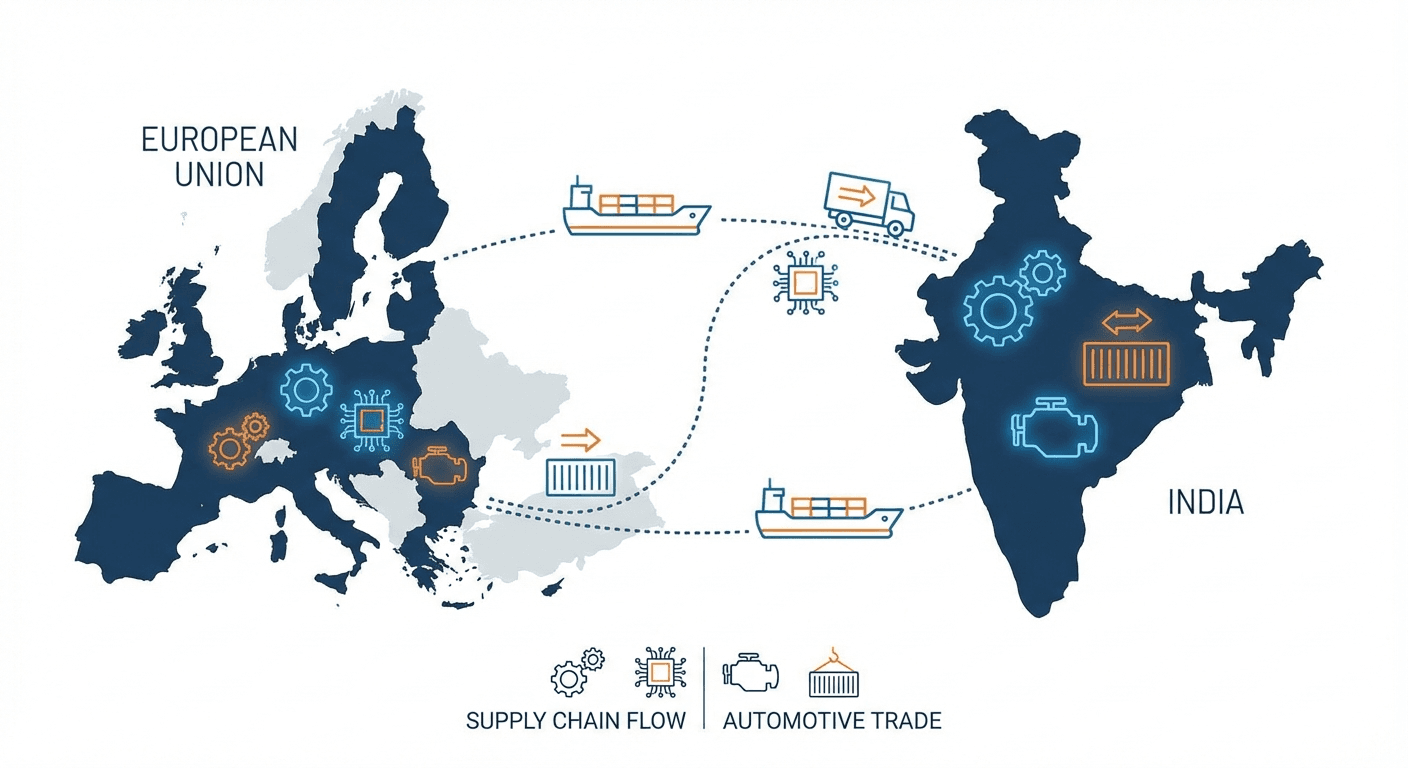
EU-India FTA: European Cars at 10% Tariff — What Tier 2 Suppliers Should Know
EU-India FTA cuts car tariffs from 110% to 10%. Zero-tariff auto components are the real prize. Tier 2 & 3 supplier action plan with timeline, BIS requirements, and first-mover advantages.