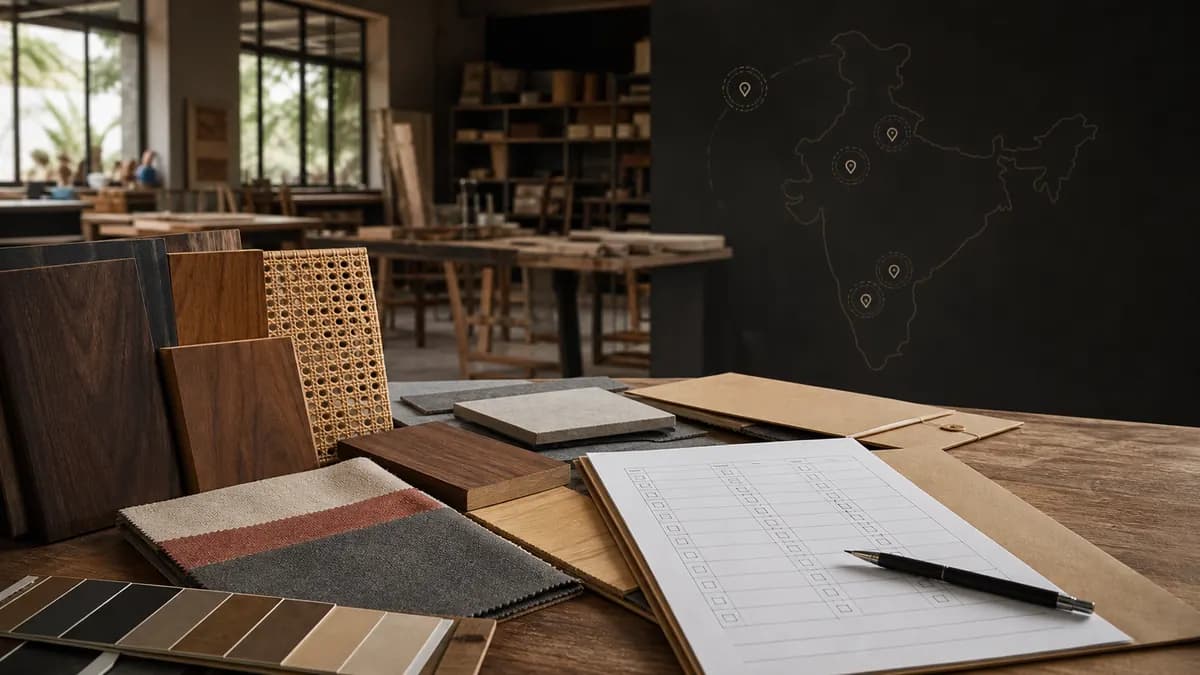
India furniture manufacturers found online should be treated as discovery leads, not approved suppliers. The source set identifies FurnitureRoots, Purewood, and Best of Exports as businesses that describe themselves as manufacturers or manufacturer-exporters (FurnitureRoots, verified July 30, 2026; Purewood, verified July 30, 2026; Best of Exports, verified July 30, 2026). None is endorsed here, and the packet does not support a universal “best” or “highest-quality” manufacturer. A Western buyer should shortlist by product fit and disclosed production role, then verify the contracting entity, factory, product documents, sample, inspection plan, and relevant claims before pilot production. A directory entry, association profile, brand, exporter label, or polished website is not factory verification.
Is an India furniture manufacturer the same as an exporter or brand?
No. In this guide, a manufacturer claim means the business says it makes furniture; an exporter claim means it says it supplies across borders; and a brand is the market-facing name. None substitutes for factory evidence. The buyer still needs to identify the contracting entity, establish where the proposed product will be made, and disclose which steps are subcontracted.
The source set illustrates the problem. Best of Exports describes itself as both an Indian furniture manufacturer and exporter, but the reviewed page’s project locations do not verify a production site (Best of Exports, verified July 30, 2026). FurnitureRoots describes itself as India-based without establishing a production location on the reviewed homepage (FurnitureRoots, verified July 30, 2026). Purewood publishes a factory address in Boranada, Jodhpur, but an address does not prove that the proposed contracting entity operates that facility (Purewood, verified July 30, 2026).
Which India furniture manufacturers belong on a buyer’s shortlist?
This dated table is for discovery. It records what each source says and no more. "Manufacturer" remains an unverified status until your own evidence checks, samples, and any required audit are complete.
| Discovery lead | What the source says | Location in the source | Source status |
|---|---|---|---|
| FurnitureRoots | The business describes itself as a commercial and hospitality furniture manufacturer. It lists hotel, restaurant, commercial, dining, living-room, outdoor, and bedroom furniture among its offerings. | Its homepage describes the business as India-based, but the page reviewed does not establish the site of production. | Official-site self-claim, verified July 30, 2026 (source). Discovery lead only. |
| Purewood | The business describes itself as a contract furniture manufacturing company and lists industrial, wooden, cane or rattan, upholstered, and custom-made furniture. | Its homepage publishes a factory address in Boranada, Jodhpur, Rajasthan. An address is not proof that the named contracting entity operates the facility. | Official-site self-claim, verified July 30, 2026 (source). Discovery lead only. |
| Best of Exports | The page describes the business as an Indian furniture manufacturer and exporter serving restaurant, café, bar, hotel, and commercial projects. | The reviewed page refers to projects across India and global markets, but that statement does not verify a production site. | Vendor page used as a discovery lead, verified July 30, 2026 (source). Not independent verification. |
There is no universal winner in the authorized packet. The shortlist is intentionally small and should be filtered against the buyer’s own specification. The AFMT website describes the Association of Furniture Manufacturers & Traders as representing manufacturers and traders, and its search tool includes both manufacturer and trader categories (AFMT, verified July 30, 2026). That makes it useful for finding candidates, but membership or a listing cannot by itself settle factory ownership or operating control.
A separate World Furniture Online report page advertises a CSIL report titled Top 100 furniture manufacturers in India. The page says the report covers rankings, turnover, product portfolios, and headquarters information; the underlying data is paid and was not used for this shortlist (World Furniture Online, verified July 30, 2026). The existence of the report does not verify any candidate in the table above.
What evidence should a buyer use to shortlist India furniture manufacturers?
Connect the proposed seller, production site, product, and purchasing decision. Use documents and direct observations to test the company claims in the table and expose unresolved questions before commercial commitment.
The source set supports only the cautious geographic observations below.
Jodhpur, Rajasthan: Purewood publishes a factory address in Boranada, Jodhpur, Rajasthan, and presents itself as a manufacturer of wooden, industrial, upholstered, cane or rattan, and custom furniture (Purewood, verified July 30, 2026). This supports a Jodhpur lead in the source set. It does not establish the size or specialization of a wider cluster.
Mumbai, Maharashtra: AFMT publishes a Mumbai address and displays featured member profiles in Mumbai on its homepage (AFMT, verified July 30, 2026). This supports Mumbai as an association and member-discovery point in the source set, not as proof of a manufacturing cluster.
FurnitureRoots describes itself as India-based but does not establish a production location on the reviewed homepage (FurnitureRoots, verified July 30, 2026). Best of Exports refers to work across multiple Indian cities, but project references do not identify where goods were manufactured (Best of Exports, verified July 30, 2026). A sourcing map should therefore begin with leads from this source set and expand only through fresh, attributable research.
For a cross-category framework covering requirements, supplier identity, samples, inspections, and approval gates, see the India sourcing evidence-led buyer's guide.
If you are comparing suppliers with a broader local-production strategy, read Manufacturing Companies in India: How to Build a Qualified Longlist. If the sourcing project is part of a commercial launch, align it with an India market-entry strategy for European SMEs.
How can a buyer verify factory versus trader status?
Do not ask only, "Are you a manufacturer?" Ask for evidence that connects the seller to the production site and your proposed product. A trader may still be a suitable counterparty, but you need to know the operating model before you assess control and traceability.
Use this verification sequence:
Identify the contracting entity. Request its exact legal name, registered address, invoicing details, and the name of the bank-account holder. Check that names match across the quotation and draft agreement. If they differ, ask for a written explanation and supporting records.
Map the production chain. Ask which operations occur at the quoted site and which are subcontracted. For furniture, this could include material preparation, machining, welding, upholstery, finishing, assembly, inspection, and packing. This is a request for disclosure, not an assumption that every operation must be in-house.
Request date-specific site evidence. Ask for a live video walkthrough showing the exterior sign, production areas relevant to your product, work in progress, quality-control records, and packing area. Have your representative choose what is shown rather than accepting a prepared marketing video.
Reconcile people and records. Ask who owns or leases the premises, who employs the workers, and whose name appears on machinery records or utility documents. Review any supplied documents for consistent entity names and addresses.
Test production knowledge. Discuss tolerances, material grades, finish systems, inspection points, and packaging decisions with the person responsible for production. Record unanswered questions and require written follow-up.
Confirm with a physical audit when needed. An independent visit can test whether the disclosed facility, workforce, process, and records correspond to the quotation. Scope the audit around your product and risks rather than relying on a generic factory tour.
Directory profiles should sit at the top of this process, never at the end. AFMT explicitly covers both furniture manufacturers and traders (AFMT, verified July 30, 2026). Apply the same discipline you would use to find a reliable distributor in India: identify the actual counterparty, verify its role, and document gaps before commercial commitment.
Need a reusable structure for supplier evidence and unresolved questions? Get the sample report.
How should furniture quality be verified before supplier selection?
Quality should be defined against the proposed product, not inferred from a “best manufacturer” label. The right evidence request depends on the product, destination market, and contract. The lists below are a due-diligence starting point, not legal, tax, customs, or certification advice.
Supplier and site documents
- Legal-entity evidence bearing the same name used in the quotation and proposed contract.
- Proof of the site address and an explanation of whether the premises are owned, leased, shared, or subcontracted.
- A process map that labels in-house and outsourced steps.
- A material list for the proposed product, with supplier declarations or test evidence where relevant.
- Quality-control forms that show inspection criteria for your sample and future production.
- A subcontractor list covering processes relevant to your order.
- Current insurance evidence where your risk review requires it.
- Copies of any certification claimed, including scope, site, entity name, issue date, expiry date, and certificate number.
Do not infer a legal requirement from this checklist. Ask qualified advisers which entity, product, labeling, safety, import, tax, or customs rules apply to the destination and transaction.
Sample package
- An approved drawing or specification tied to a sample identifier.
- The bill of materials for that sample, including declared wood species or substrate and finish.
- Finish samples viewed under agreed conditions before the full piece is approved.
- Hardware details and replaceable-component references.
- Measurements and inspection results against the agreed drawing.
- Packaging specification with photos of the packed sample.
- A written deviation log for anything that differs from the approved specification.
- A sealed or otherwise controlled reference sample if repeatability matters.
How should sustainability claims be checked?
Furniture sustainability language can refer to material origin, recycled content, forestry practices, chemical use, packaging, or factory operations. Ask the supplier to convert each broad statement into a precise claim with a defined scope.
FurnitureRoots states that it is FSC-certified and publishes a licence number on its homepage (FurnitureRoots, verified July 30, 2026). That is a supplier self-claim at the discovery stage. Purewood states that its wood comes from "right and legal sources" and says buyers can ask for a certificate and permission (Purewood, verified July 30, 2026). That also remains a supplier self-claim until checked against documents and the relevant issuing source.
For any sustainability or certification claim:
- Record the exact wording used by the supplier.
- Identify the legal entity and physical site covered.
- Obtain the certificate and its scope rather than a logo or screenshot.
- Check current status with the named scheme owner or certificate issuer.
- Match purchase records and material descriptions to the claimed input.
- Trace the claim through subcontracted operations and mixed materials.
- Put approved wording and evidence duties into the purchasing specification.
Do not present a supplier's certification as verified merely because a certificate file exists. Confirm its current status, scope, named entity, site, and relevance to the specific product. If your marketing or customer contract will repeat the claim, obtain advice on the wording you may use.
How should a buyer run a pilot and inspection before production?
Use the approved sample as controlled evidence for the pilot decision: connect it to the approved drawing, bill of materials, finish and hardware references, measurements, packaging evidence, and deviation log. Sample approval proves only what was reviewed in that sample. It does not prove that later production will match. Purchase documents should therefore define the approved reference, permissible changes, inspection method, and response to nonconformity. Obtain professional contract advice for the governing terms.
The inspection plan should follow unresolved product and process questions. Ask for quality-control forms that state the inspection criteria for the sample and future production. If remote evidence is insufficient, an independent site visit can compare the disclosed facility, workforce, processes, records, bill of materials, and quality plan with the quotation.
When is an on-site audit needed?
An audit is warranted when remote evidence leaves a material question unanswered or when the impact of a false assumption is unacceptable. There is no universal order value or timetable that makes an audit mandatory in every case.
Consider an on-site audit when:
- The seller's legal entity cannot be clearly linked to the proposed factory.
- Subcontracting affects a critical process or claimed material traceability.
- The product is custom and failures would be difficult to correct after shipment.
- Documents conflict on names, addresses, process ownership, or certification scope.
- A live video visit does not show the relevant equipment, records, or work in progress.
- The supplier resists reasonable disclosure about production and inspection.
- Your customer, insurer, contract, or internal risk policy requires independent confirmation.
The audit scope should follow the open questions. A site tour can confirm that a building and equipment exist, but a useful audit also samples records, observes relevant processes, and reconciles what is seen with the proposed bill of materials and quality plan. If environmental, labor, safety, or legal compliance is in scope, appoint a qualified specialist and define the applicable standard before the visit.
What selection checklist should a Western furniture buyer use?
Use this final gate before moving a discovery lead into pilot production:
- Counterparty: Is the exact contracting entity consistent across the quotation, proposed agreement, invoicing details, and bank-account name?
- Factory role: Does the evidence connect that entity to the proposed production site, with in-house and subcontracted operations disclosed?
- Product definition: Are the drawing, bill of materials, materials, finish, hardware, measurements, and permissible changes documented?
- Sample control: Is the approved sample identifiable, with inspection results, packaging evidence, and deviations recorded?
- Claims: Have certification and sustainability statements been checked for current status, scope, entity, site, and relevance to the product?
- Inspection: Does the inspection or audit scope answer the material open questions instead of repeating a generic factory tour?
- Decision record: Does the file distinguish supplier statements, buyer-verified evidence, unresolved points, and the next action?
A “yes” should point to evidence in the decision file. A gap does not automatically disqualify a supplier, but it should remain visible and receive an owner and next check before approval. For a broader evidence structure, use the India sourcing evidence-led buyer’s guide. For a cross-sector longlisting method, see Manufacturing Companies in India: How to Build a Qualified Longlist.
FAQ
Who are furniture manufacturers in India?
The allowed sources provide three current discovery leads: FurnitureRoots, Purewood, and Best of Exports, each of which describes itself as a furniture manufacturer or manufacturer-exporter (FurnitureRoots; Purewood; Best of Exports, all verified July 30, 2026). These are not endorsements or independently verified factory statuses. AFMT can generate additional leads, but its listings should not be treated as proof (AFMT).
Which is the best furniture manufacturer in India?
No universal winner follows from the authorized source set. FurnitureRoots, Purewood, and Best of Exports are discovery leads based on their own published descriptions, not a quality ranking (FurnitureRoots; Purewood; Best of Exports, all verified July 30, 2026). Define “best” against the product specification, disclosed production role, documented sample, verified claims, and open questions resolved by inspection.
Is a furniture exporter always the manufacturer?
Do not infer factory status from the exporter label. Best of Exports describes itself as both a manufacturer and exporter, but its reviewed project references do not identify the production site (Best of Exports, verified July 30, 2026). Verify the contracting entity, actual factory, and subcontracted operations for the proposed order.
Can an association membership verify manufacturer status?
Not by itself. AFMT describes itself as an association for furniture manufacturers and traders, and its website separates several business categories (AFMT, verified July 30, 2026). A profile can help identify a candidate, but factory status still requires direct evidence.
What should a furniture sample include?
Tie the sample to an approved drawing and bill of materials. Add finish references, hardware details, inspection results, packaging evidence, and a deviation log. The exact package should reflect the product and destination requirements, with specialist advice where necessary.
How do I verify a sustainability certification?
Obtain the certificate, check the named entity and site, confirm current status and scope with the issuer or scheme owner, and connect the claim to the actual materials in your order. FurnitureRoots' published FSC statement and Purewood's legal-sourcing statement are self-claims until that checking is complete (FurnitureRoots; Purewood, verified July 30, 2026).
Should I audit every furniture supplier in India?
Use a risk-based decision. Audit when factory identity, subcontracting, traceability, process capability, or document consistency remains materially uncertain. Also audit when a binding customer, insurer, contract, or internal policy requires it. Seek specialist advice for any legal or compliance scope.
Turn a longlist into an evidence-backed shortlist
The useful output is not a longer vendor list. It is a decision record showing what each candidate claims, what the evidence supports, what remains unresolved, and which next check could change the sourcing decision. Keep every company as a discovery lead until its documents and samples have been reviewed and the relevant factory has passed any audit your risk assessment requires.
Get the sample report to see how evidence gaps and next actions can be organized for a market or supplier decision.
Written by Tileo, an operator with a decade of Europe-Asia industrial trade programs.
Read the methodology, source date and confidence level before carrying a number into a decision.
What does the FTA change for your product?
Open the Tariff Calculator →Every figure above is dated and source-attributed. Nothing arrives as an unexplained number.
- Sources are listed in the report methodology and verified against the publication date.
- Regulatory outcomes remain subject to entry-into-force dates and line-level classification.
Continue the research
Choose the next evidence step
Use this briefing as context, then choose the format that fits the question you need to answer.
Standard report
Start with a dated baseline
Use a fixed-scope report when you need a sourced answer to a defined market question.
ExploreCustom MIR
Shape the question around your case
Carry this article’s question into one target market, sector, corridor, and decision brief.
ExploreScoping call
Talk through the decision
Bring the corridor, timing, and evidence gap to a call before choosing the right format.
ExploreRelated Intelligence

India Pharma Equipment Market: Opportunities for Western Manufacturers
Market sizing, competitive landscape, regulatory requirements, and entry strategy for European and American pharmaceutical equipment manufacturers targeting India's $55B pharma industry.

India Manufacturing Products: A Buyer Shortlist Frame
A decision frame for Western SMEs shortlisting India manufacturing products using sector signals, export evidence and product-level compliance gates.
India Manufacturing: A Market-Entry Decision Guide
A practical guide for Western manufacturers choosing an India entry route, cluster, partner, controls, landed economics and pilot.